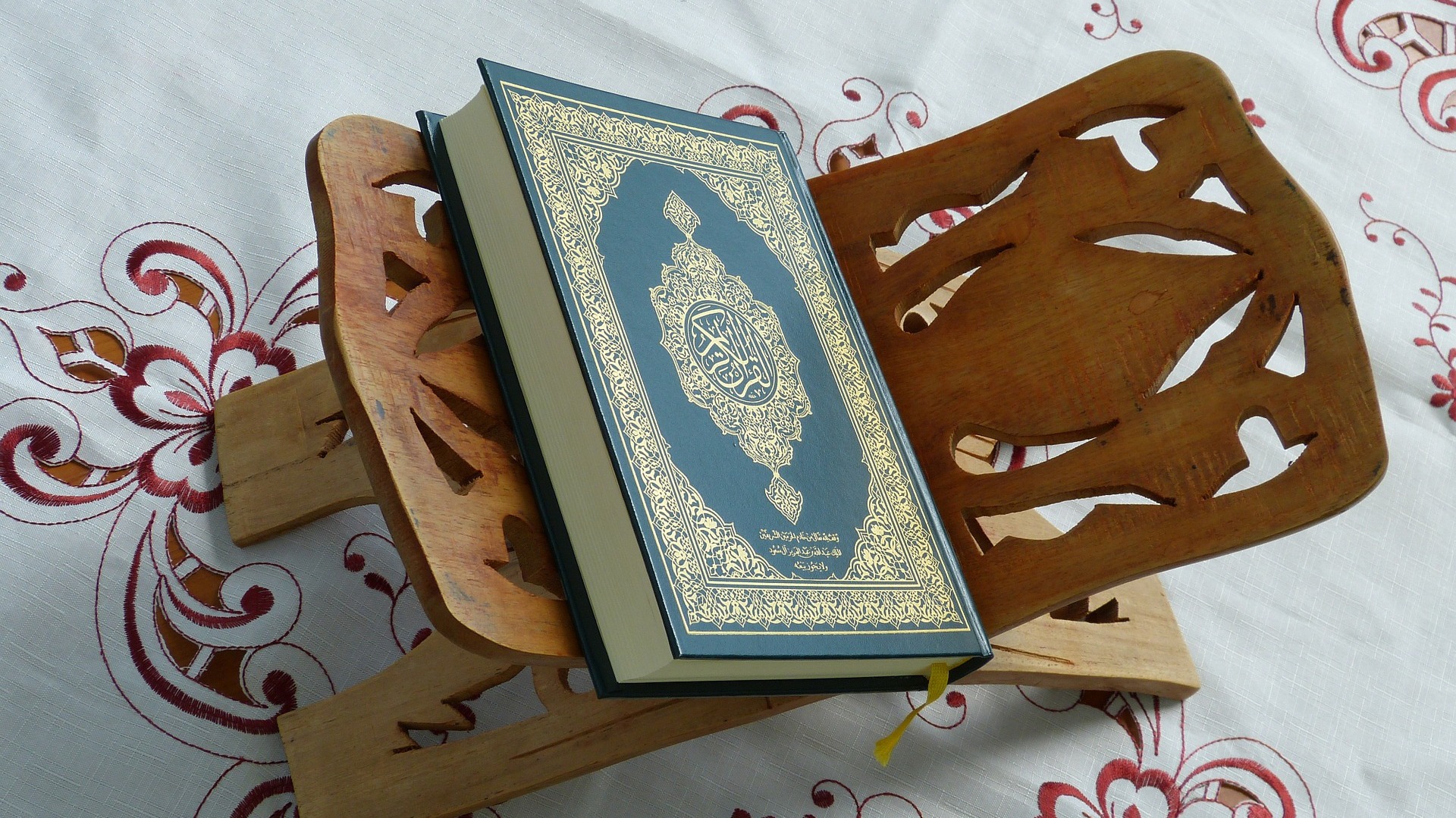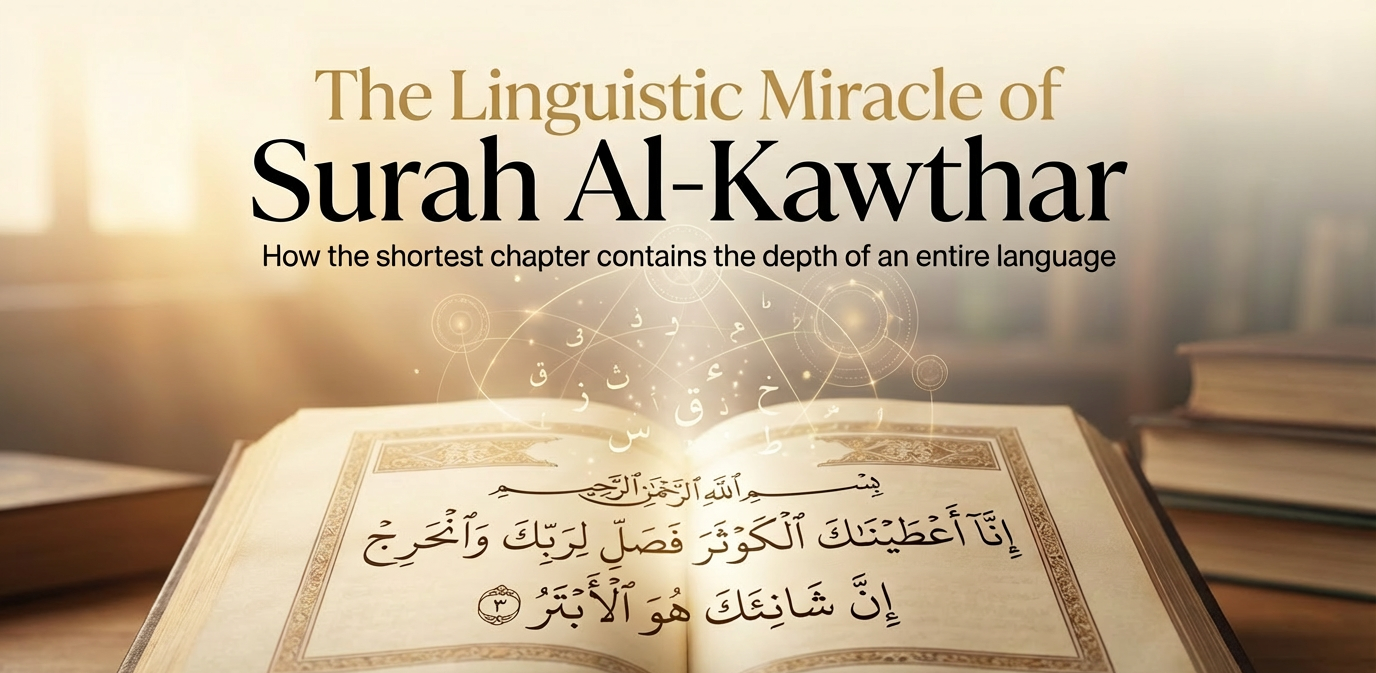
Surah Al-Kawthar is the shortest chapter in the Qur’an.
Only three verses, recited easily by children and memorized by millions:
إِنَّا أَعْطَيْنَاكَ الْكَوْثَرَ
فَصَلِّ لِرَبِّكَ وَانْحَرْ
إِنَّ شَانِئَكَ هُوَ الْأَبْتَرُ
Yet beneath this apparent simplicity lies a level of linguistic precision and structural richness that continues to astonish linguists, grammarians, and students of Arabic alike.
This article explores the linguistic miracle of Surah Al-Kawthar, focusing on how a chapter of just three verses manages to reflect nearly the entire framework of the Arabic language.
--------------------------
A Small Chapter with a Big Challenge
Surah Al-Kawthar consists of only three verses and ten words:
- إِنَّا
- أَعْطَيْنَاكَ
- الْكَوْثَرَ
- فَصَلِّ
- لِرَبِّكَ
- وَانْحَرْ
- إِنَّ
- شَانِئَكَ
- هُوَ
- الْأَبْتَرُ
At first glance, it may seem too short to carry deep linguistic complexity. However, when examined carefully, the opposite becomes clear.
The remarkable feature of this surah is not only what it says, but how it says it — with an economy of language that leaves no space for excess, yet no room for deficiency.
---------------------------
Numerical Precision Beyond Coincidence
One of the most striking aspects of Surah Al-Kawthar is its numerical balance.
- The entire surah consists of exactly 10 words.
- Each verse contains exactly 10 unique (non-repeated) letters.
Verse-by-verse breakdown:
Verse 1 – إِنَّا أَعْطَيْنَاكَ الْكَوْثَرَ
Unique letters (10):
ا – ن – ع – ط – ي – ك – ل – و – ث – ر
Verse 2 – فَصَلِّ لِرَبِّكَ وَانْحَرْ
Unique letters (10):
ف – ص – ل – ر – ب – ك – و – ا – ن – ح
Verse 3 – إِنَّ شَانِئَكَ هُوَ الْأَبْتَرُ
Unique letters (10):
ا – ن – ش – ك – ه – و – ل – ب – ت – ر
This perfect balance repeats across all three verses, dramatically reducing the likelihood of coincidence.
Even more astonishing is that:
- Exactly 10 Arabic letters appear only once in the entire chapter.
These letters are:
ع – ط – ي – ث – ف – ص – ح – ش – ه – ت
Such a rare distribution strongly suggests deliberate linguistic design rather than random occurrence.
---------------------------
A Complete Spectrum of Sentence Types
In Arabic rhetoric (Balāghah), sentences are broadly classified into declarative (khabariyyah) and imperative (inshā’iyyah) forms. Remarkably, Surah Al-Kawthar includes both types within its three short verses.
Declarative sentences appear in:
- إِنَّا أَعْطَيْنَاكَ الْكَوْثَرَ
- إِنَّ شَانِئَكَ هُوَ الْأَبْتَرُ
Imperative sentences appear in:
- فَصَلِّ لِرَبِّكَ
- وَانْحَرْ
From a grammatical perspective, Arabic sentences are also divided into nominal sentences (جملة اسمية) and verbal sentences (جملة فعلية). Once again, both types are present in Surah Al-Kawthar:
- Nominal sentence:
إِنَّ شَانِئَكَ هُوَ الْأَبْتَرُ - Verbal sentence:
فَصَلِّ لِرَبِّكَ وَانْحَرْ
Beyond this, classical Arabic grammarians further classify sentences into simple (minor) sentences and compound (major) sentences.
- A simple (minor) sentence (جملة صغرى) consists of a basic structure, such as verb + subject or subject + predicate.
Example from the surah:
فَصَلِّ لِرَبِّكَ — a verbal structure consisting of a verb, an implied subject, and its object. - A compound (major) sentence (جملة كبرى) is a sentence whose predicate is itself another complete sentence.
Example from the surah:
إِنَّا أَعْطَيْنَاكَ الْكَوْثَرَ — where inna and its noun are followed by a verbal sentence functioning as the predicate.
Even advanced rhetorical concepts such as connection and separation (الوصل والفصل) appear naturally:
- وَانْحَرْ (connection)
- إِنَّ شَانِئَكَ هُوَ الْأَبْتَرُ (separation)
All of this linguistic diversity occurs within only three verses, highlighting a level of structural richness that is exceptionally rare in human language.
---------------------------
A Complete Pronoun System in Surah Al-Kawthar
One of the most remarkable linguistic features of Surah Al-Kawthar is that it contains all major classifications of Arabic pronouns (الضمائر) within only three short verses. This comprehensive system reflects an extraordinary level of linguistic precision and balance.
1. Pronouns by Visibility
Explicit Pronouns (ضمير بارز) and Implicit Pronouns (ضمير مستتر)
- Explicit pronouns (ضمير بارز):
هُوَ
The attached كَ in: أَعْطَيْنَاكَ – لِرَبِّكَ – شَانِئَكَ - Implicit pronouns (ضمير مستتر):
The hidden pronoun “you” (أنت) in the imperative verbs:
فَصَلِّ and وَانْحَرْ
2. Pronouns by Attachment
Detached Pronouns (ضمير منفصل) and Attached Pronouns (ضمير متصل)
- Detached pronoun (ضمير منفصل):
هُوَ - Attached pronouns (ضمير متصل):
نَا in أَعْطَيْنَا
كَ in أَعْطَيْنَاكَ – لِرَبِّكَ – شَانِئَكَ
3. Pronouns by Person
Speaker, Addressee, and Absent (متكلم – مخاطب – غائب)
- First person / Speaker (ضمير المتكلم):
نَا in أَعْطَيْنَا - Second person / Addressee (ضمير المخاطب):
كَ in أَعْطَيْنَاكَ and لِرَبِّكَ
The implicit أنت in فَصَلِّ and وَانْحَرْ - Third person / Absent (ضمير الغائب):
هُوَ in: إِنَّ شَانِئَكَ هُوَ الْأَبْتَرُ
4. Pronouns by Grammatical Case
Nominative, Accusative, and Genitive (محل رفع – نصب – جر)
- Pronoun in the nominative case (في محل رفع):
نَا in أَعْطَيْنَا (subject / فاعل)
هُوَ in إِنَّ شَانِئَكَ هُوَ الْأَبْتَرُ (subject or pronoun of separation – ضمير فصل) - Pronoun in the accusative case (في محل نصب):
كَ in أَعْطَيْنَاكَ (direct object / مفعول به) - Pronoun in the genitive case (في محل جر):
كَ in لِرَبِّكَ (possessive construction / مضاف إليه)
In just three verses, Surah Al-Kawthar brings together every fundamental pronoun category recognized by Arabic grammarians, forming a complete grammatical system within the shortest chapter of the Qur’an—an unmistakable sign of its linguistic miracle.
---------------------------
Remarkable Verb Diversity
Although Surah Al-Kawthar contains only three verbs, they represent an impressive range of Arabic morphology:
1. Verb Types by Root Structure
- Sound, Weak, and Doubled Verbs (صحيح – معتل – مضعف)
- Sound verb (فعل صحيح):
نَحَرَ - Weak verb (فعل معتل):
أَعْطَى - Doubled verb (فعل مضعف):
صَلَّى
- Sound verb (فعل صحيح):
2. Verb Types by Form
- Simple and Augmented Forms (مجرد – مزيد)
- Simple triliteral verb (فعل مجرد ثلاثي):
نَحَرَ - Augmented verb (فعل مزيد):
أَعْطَى
- Simple triliteral verb (فعل مجرد ثلاثي):
3. Verb Types by Transitivity
- Intransitive and Transitive Verbs (لازم – متعدٍ)
- Intransitive verb (فعل لازم):
صَلَّى - Transitive verb requiring one object (فعل متعدٍ إلى مفعول واحد):
نَحَرَ - Transitive verb requiring two objects (فعل متعدٍ إلى مفعولين):
أَعْطَى
- Intransitive verb (فعل لازم):
From a linguistic standpoint, this level of diversity is extraordinary — especially within such limited space.
---------------------------
Maximum Meaning, Minimum Words
What makes this linguistic miracle even more powerful is that it is not artificial. The surah does not read like a grammar exercise. It flows naturally, carries deep meaning, and delivers a strong emotional and spiritual message.
Human speech often sacrifices clarity for complexity, or simplicity for depth. Surah Al-Kawthar achieves both simultaneously.
More Than Structure: A Deeper Miracle
Everything discussed so far relates only to:
- Letters
- Words
- Grammar
- Linguistic structure
We have not yet touched on:
- The miracle of meaning
- Rhetorical power
- Psychological and spiritual impact
- Historical context
If the shortest chapter of the Qur’an contains such richness at the structural level alone, what does that suggest about the Qur’an as a whole?
---------------------------
Final Reflection
Surah Al-Kawthar is not merely short — it is densely perfect. It challenges the idea that depth requires length and proves that true mastery of language lies in precision, balance, and purpose.
The shortest chapter in the Qur’an nearly contains the entire system of the Arabic language. Is this not a linguistic miracle?
Zajel Institute
Teaching Arabic with depth, clarity, and purpose.